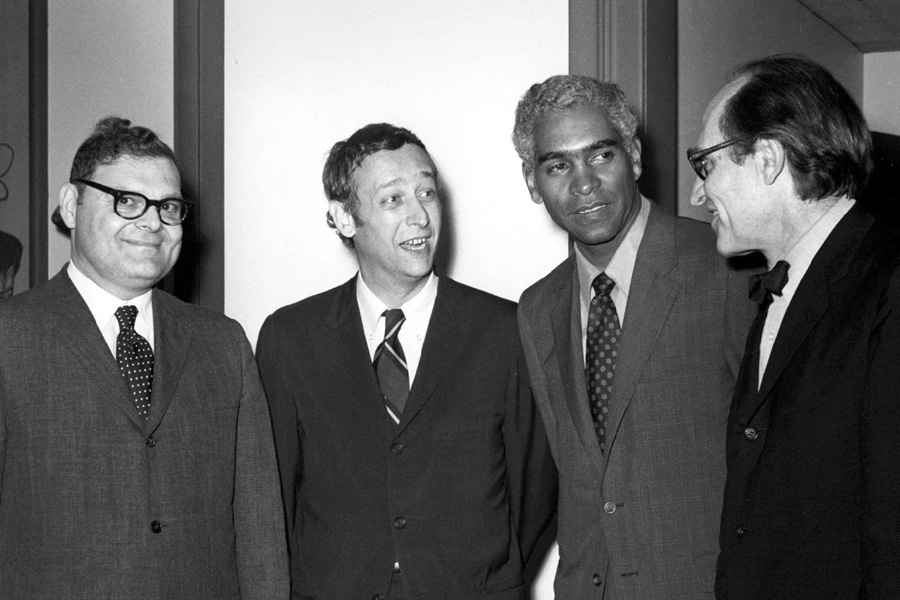
Basic Information
| Field | Detail |
|---|---|
| Full name | John Warren Moutoussamy |
| Common form | John W. Moutoussamy |
| Born | January 5, 1922, Chicago, Illinois |
| Died | May 6, 1995, Chicago, Illinois |
| Education | Illinois Institute of Technology, studied under Ludwig Mies van der Rohe |
| Military service | World War II veteran; used the GI Bill to study architecture |
| Occupation | Architect; partner and managing partner at Dubin, Dubin & Moutoussamy |
| Signature work | Johnson Publishing Company building, 820 S. Michigan Avenue, Chicago (completed 1971) |
| Other notable projects | Richard J. Daley College, Olive-Harvey College, Harry S. Truman College, Bessie Coleman Library, Chicago Urban League building, Regents Park towers |
| Spouse | Elizabeth Hunt |
| Children | John Jr., Claude, Jeanne Moutoussamy-Ashe (born July 9, 1951) |
| Notable descendant | Granddaughter Camera Ashe |
A life built from service and study
John Moutoussamy grew up in Chicago and answered the call of his country in World War II. After the war he channeled the benefits of the GI Bill into an education at the Illinois Institute of Technology, where he studied in the shadow of modernist discipline with Ludwig Mies van der Rohe. That training delivered a precise sense of proportion and an economy of form, but Moutoussamy added a different light to the modern vocabulary: warmth, color, and a civic imagination rooted in community.
From draftsman to partner: professional trajectory
Moutoussamy rose through practice in midcentury Chicago and moved into partnership roles that were rare for an African-American architect of his era. He became a named partner in a major local firm, joining Dubin, Dubin & Moutoussamy and later managing the practice. Across the 1950s to 1980s he executed institutional, residential, and civic commissions that ranged from college buildings to public libraries and mixed-use housing. Numbers tell part of the story: an 11-story corporate headquarters in 1971, multiple college buildings in the 1970s, and high-rise residential work in the Hyde Park area.
The Johnson Publishing Company building: a defiant headquarters
Completed in 1971, the Johnson Publishing Company building at 820 South Michigan Avenue stands as Moutoussamy’s most visible, defining work. The 11-story headquarters housed the editorial operations of Ebony and Jet and served as a cultural beacon for Black America. Designing a downtown high-rise for a Black-owned national publisher was, in concrete and glass, a statement about presence and civic claim. The project combined a clear urban posture with interiors that celebrated the human scale; it read as modern architecture that refused sterility and instead embraced color and life.
Architecture of institutions and neighborhoods
Moutoussamy’s portfolio reaches into the everyday institutions that shape a city: community colleges, libraries, and civic organizations. He designed buildings for Richard J. Daley College, Olive-Harvey College, and Harry S. Truman College, and he contributed to the built fabric of neighborhoods through residential towers and the Chicago Urban League building. These projects reveal a commitment to enabling public life through durable design, and they show how midcentury modernism could be adapted to local needs.
Boards, honors, and civic presence
Beyond drawing boards and construction sites, Moutoussamy took on civic responsibilities. He served on boards and as a trustee in major cultural and educational institutions in Chicago and accepted honors that recognized his civic contributions. An honorary degree from a local university in the early 1980s reflects how his peers and institutions acknowledged his leadership. His public roles made him part of the conversation about planning and cultural stewardship in the city.
Family: roots, lineage, and artistic continuance
Family anchored Moutoussamy’s life. His paternal roots trace to Guadeloupe and his maternal connections to Louisiana; those origins became part of a layered identity that the family carried forward. He married Elizabeth Hunt and fathered three children, among them Jeanne Moutoussamy-Ashe, a noted photographer born July 9, 1951, who married tennis champion Arthur Ashe and later adopted Camera Ashe, John’s granddaughter. Jeanne’s career in visual art and the family’s public life extend the Moutoussamy influence across photography, activism, and cultural memory.
Timeline of key events
| Year / Period | Event |
|---|---|
| 1922 | Born January 5 in Chicago |
| 1940s | Served in World War II; after service used GI Bill for architecture studies |
| 1948 | Completed architecture studies at Illinois Institute of Technology |
| 1950s to 1960s | Early career and establishment of his practice; rose to partnership |
| 1971 | Johnson Publishing Company building completed at 820 S. Michigan Avenue |
| 1970s to 1980s | Designed multiple college and public buildings; served on civic boards |
| Early 1980s | Received an honorary degree from a local university |
| 1995 | Died May 6 while at a golf course in Burnham Woods |
Legacy in stone, steel, and memory
Moutoussamy’s work circulates in two registers: physical buildings that still shape neighborhoods and a symbolic record that places him among the architects who expanded the possibilities for African-American professionals in the second half of the 20th century. The headquarters he designed is more than architecture; it is an artifact of cultural aspiration, a place where editorial rooms and community gatherings once converged. His projects continue to be read, repurposed, and reassessed as cities adapt and remember.
FAQ
Who was John Moutoussamy?
John Moutoussamy was a Chicago-born architect, born January 5, 1922, who trained at the Illinois Institute of Technology and became the first African-American architect to design a downtown Chicago high-rise. He built a career designing institutional, residential, and civic buildings and served on several cultural boards.
What is the Johnson Publishing Company building?
The Johnson Publishing Company building is an 11-story headquarters completed in 1971 at 820 South Michigan Avenue, designed by Moutoussamy for the publishers of Ebony and Jet, and recognized for its cultural and architectural significance.
Which public institutions did he design buildings for?
He designed facilities for community colleges and public institutions, including Richard J. Daley College, Olive-Harvey College, and Harry S. Truman College, among others.
Who were his immediate family members?
He was married to Elizabeth Hunt and had three children: John Jr., Claude, and Jeanne Moutoussamy-Ashe, with granddaughter Camera Ashe among his known descendants.
How did his early life influence his career?
Military service in World War II and the subsequent GI Bill enabled his studies at a major modernist school, shaping a career that combined technical rigor with community-focused commissions.
Is his work still visible today?
Yes, many of his buildings remain parts of Chicago’s urban fabric, and his signature project continues to attract attention as it has been repurposed and remembered in recent years.